


Documenting the bleaching practices in Jamaica, this video provides considerable insight into the psychological mechanisms that trigger the desire to remove one's melanin.
Using traditional Indian sounds and dance routines, these young women counter societal norms and wish for a dark skinned lover. "Tamil", which means ‘black is my favorite color’, captures the fight to appreciation all skin complexions.
Colorism manifests not only in the United States but in other countries as well. Colorist ideologies and hierarchal perceptions of skin color can be found in Jamaica, India, China, and various parts of Africa. And while the contrasting sociocultural contexts yield varied behavioral and cognitive outcomes, each system of colorism is consistent in its degradation of dark skin and preference for light skin.

Although Usain Bolt, Yohan Blake, and Veronica Campbell are all dark skin, in the cartoon they are depicted considerably lighter--indicating the pictured hue is the preferable one.


Excerpt from qualitative study conducted by Charles (2011): "Mi like fi bleach because it mek mi look pretty" Translation: I like to bleach because it makes me look pretty "Mi look good when mi brown, " Translation: I look pretty when I am brown.
Although Usain Bolt, Yohan Blake, and Veronica Campbell are all dark skin, in the cartoon they are depicted considerably lighter--indicating the pictured hue is the preferable one.
Colorism Internationally
Colorism is a serious problem in Jamaica. The elevated perception of light skin has led to bleaching practices as well as clear media misrepresentations of dark skin athletes and celebrities. Empirical research has also explored colorism in Jamaica. Goupal-McNicol (1999) & Cramer and Anderson (2003) found children and adolescents in Jamaica to identify those with white skin to be “nice”, “decent”, “beautiful”, “sexy”, and “intelligent”. Charles (2011) found colorism influences mating selection and bleaching practices in Jamaica, such that women bleached to be more sexually attractive.
Jamaica

Model Lakshmi Menon's (left) dark skin makes her more sought-after abroad, while actress Sonam Kapoor's (right) pale complexion renders her extremely appealing to Indian advertisers.

The desire to light extends to Indian men as well.

When exploring the Indian caste system, one finds that it also coincides with the color spectrum, such that those who are lighter are at the top while darker Indians are relegated to the bottom.
Model Lakshmi Menon's (left) dark skin makes her more sought-after abroad, while actress Sonam Kapoor's (right) pale complexion renders her extremely appealing to Indian advertisers.
In India there is a clear preference for lighter skin individuals. In fact, the country's traditional caste system reflects the societal endorsement of a skin color hierarchy. Those whom are darker often engage in hard labor, leading to the darkening of the skin. While those that are more prestigious and socially mobile are often in positions of power and indoors, protected from the sun and as a result, lighter.
India

While it may appear strange to others, Chinese women are wearing these masks to protect their skin from the sun and becoming darker.

The traditional use of white makeup to achieve a fairer complexion is one that reflects colorist ideologies as well as a deep seeded desire for lightness.

Bleaching creams and lotions make up about 30% of total skin care products in China. Capitalizing on the Chinese obsession with fair skin, companies are making millions.
While it may appear strange to others, Chinese women are wearing these masks to protect their skin from the sun and becoming darker.
China
In China the historical appreciation of pale skin is quite clear. Skin lightening products are high in demand and those that achieve a fair complexion are heralded as beauties. Most recently, in an attempt to maintain their lightness, Chinese women have used masks to cover their faces while visiting the beach.
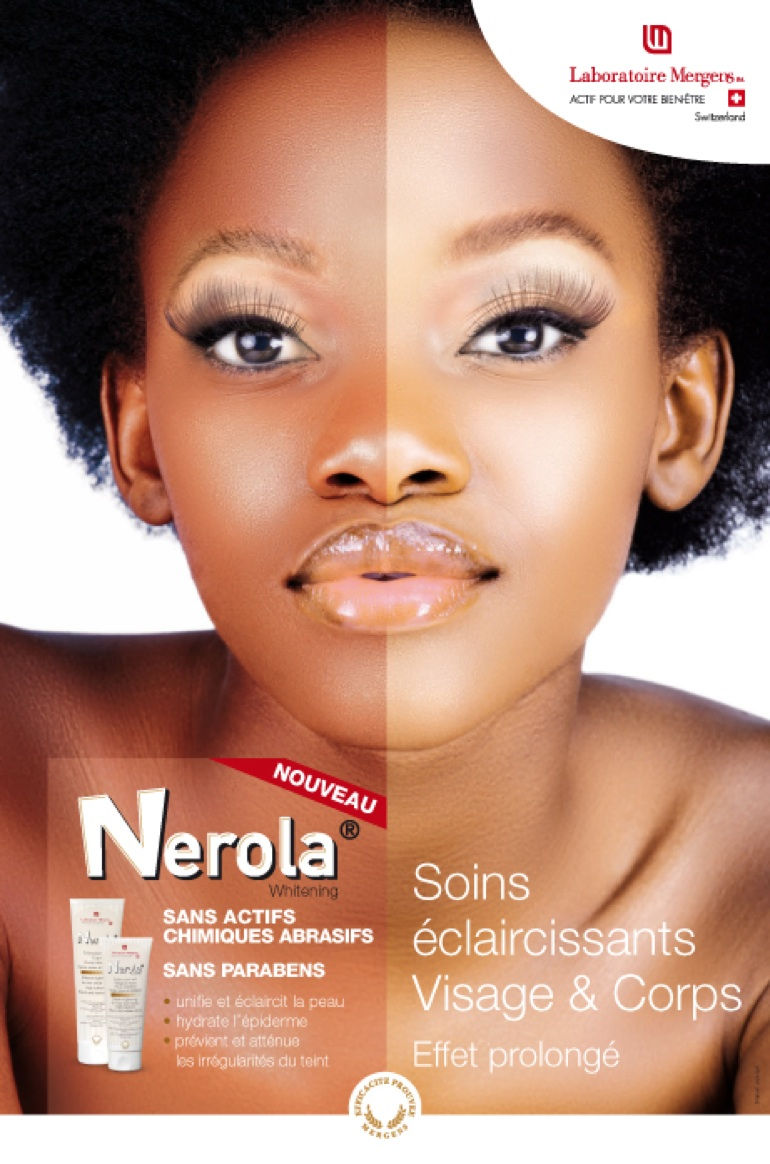
African women are bombarded with images suggesting that they alter their complexions.
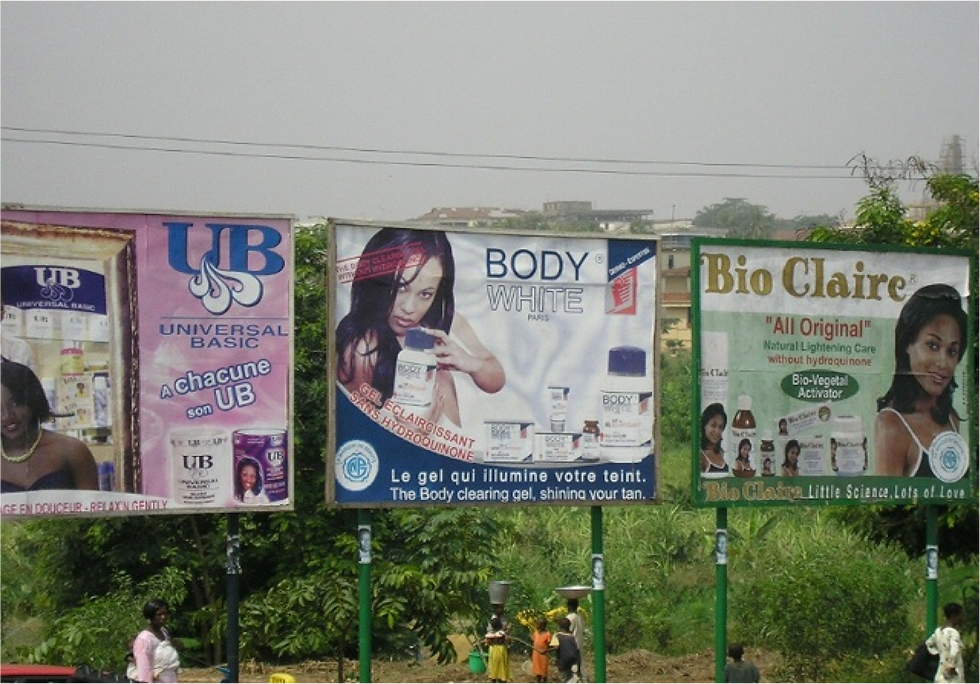

In Africa, one may find numerous billboards advocating bleaching practices
African women are bombarded with images suggesting that they alter their complexions.
Africa
International Videos About Skin Color
Skin bleaching practices are a serious issue in Africa. Del Guidice & Yves (2001)
surveyed 685 Senegalese women and
found 36% of the women (246) used bleaching creams. Unfortunately, many of these participants presented adverse skin effects. Despite efforts to curb bleaching, billboards and magazines are filled with lightening cream advertisements.
Ee'da is a Indian artist that uses spoken word to narrate her life experiences with color consciousness and the unfortunate practice of bleaching in India.
Despite the bleaching practices and colorist ideologies endorsed in Jamaica, reggae artist Richie Spice countered the work of Vybz Kartel and created an ode to all women of color, regardless of their hue.