What is Colorism?
Coined by Alice Walker in 1982, colorism is defined as an intraracial and interracial system of inequality based on skin color, hair texture, and facial features (Wilder, 2010). It manifests all over the world and has a significant influence on varied behavioral and cognitive outcomes. Empirical studies of skin color have found darker skin individuals to experience more racial discrimination (Klonoff & Landrine, 2000), receive harsher legal punishments (Eberhardt, Davies, Purdie-Vaughns, & Johnson, 2006) and be considered less attractive (Watson, Thorton, Engelland, 2010).
The unequal value assigned to skin color, if internalized, can lead individuals to perceive themselves or others in a biased light (Russell, Wilson, & Hall 1992; Hall, 1992). As such, social and personal evaluations of skin color have become the focal point of research across varied disciplines, with a particular interest in how colorism affects social processes.
But how has this system of inequality sustained itself? How do people learn about skin color hierarchies? And what are the consequences of colorism around the world?
The aim of this website is to address these questions and broadly explore colorism and socialization from an international perspective. Learn and become informed.
Colorism and Socialization
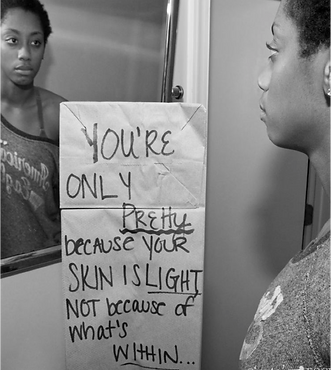
Breonca Trofort 'Auto' Focus Image- http://btrofort.wordpress.com/tag/breonca-trofort/